Introduction: The Digital Transformation of Land Records in Tamil Nadu
For property owners and prospective buyers in Tamil Nadu, accurate land records are the foundation of legal security and financial transparency. Since the digitization wave was formalized in 2015, the Government of Tamil Nadu has transitioned from manual, ledger-based record-keeping to a sophisticated “Anytime/Anywhere” e-portal.
The backend of this ecosystem is powered by the Tamil Nilam (Tamil Nadu Information System for Land Administration) application software. This system has revolutionized land governance by centralizing data, enabling real-time updates, and eliminating the necessity for physical visits to government offices for basic documentation. This guide serves as a technical roadmap for navigating the e-services portal (eservices.tn.gov.in) to view, download, verify, and transfer land records.
Understanding the Terminology: Patta vs. Chitta vs. Adangal
Technical precision is vital when dealing with the Department of Survey and Settlement. While “Patta Chitta” is often used as a single term today, each component serves a specific legal function.
- Patta: The primary legal document conferring ownership and rights over an immovable property. It acts as the “Record of Rights” (ROR) proving title.
- Chitta: A land revenue record detailing the classification (e.g., residential vs. agricultural), area, and usage of the land.
- Adangal: A critical cultivation record maintained by the Village Administrative Officer (VAO). It documents land area, crop details, and the identity of those cultivating the land.
- The 2015 Merger: To simplify due diligence, the government integrated Patta and Chitta into a single extract. Chitta is no longer issued as a standalone document for deeds registered after 2015.
Technical Comparison of Land Records
| Record Type | Focus | Key Information | Issuing Authority |
| Patta | Ownership Title | Owner name, Patta number, Survey/Subdivision number, and Tax details. | Dept. of Survey and Settlement (Tahsildar Approval) |
| Chitta | Land Revenue/Usage | Total area, size, and land nature (Wetland vs. Dryland). | Dept. of Survey and Settlement (Maintained by VAO) |
| A-Register Extract | History & Rights | Detailed ROR, comprehensive ownership history, tax data, and encumbrances. | Department of Revenue Administration |
Land Classification: Nanjai vs. Punjai
Land classification dictates both tax liability and potential for future development:
- Nanjai (Wetland): Land with abundant water resources (canals/rivers). These parcels carry higher tax implications and face significantly stricter government regulations regarding conversion for non-agricultural use.
- Punjai (Dryland): Land with limited water facilities, usually dependent on rainfall or wells. These generally have more flexibility for development compared to Nanjai land.
Step-by-Step Guide: Viewing and Downloading Patta Chitta Online
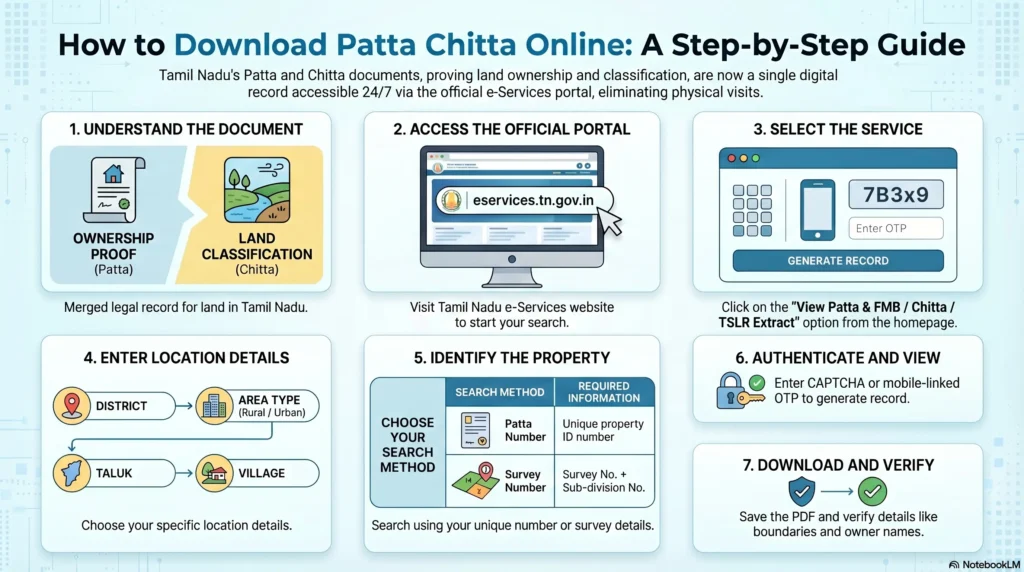
Accessing the Tamil Nilam database is done through the official portal: eservices.tn.gov.in.
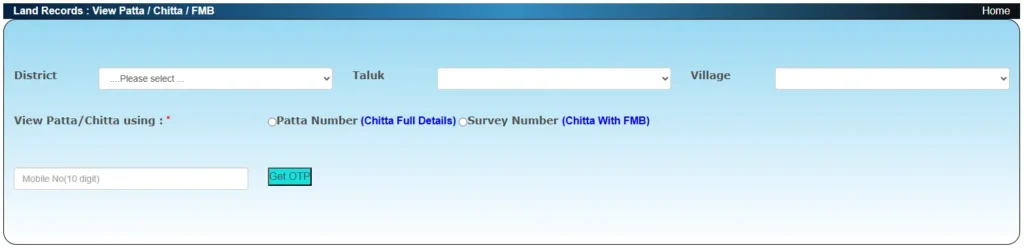
- Select the Service: Click on “View Patta & FMB / Chitta / TSLR Extract.”
- Define Area Type: Choose between Rural (Uragam/Natham) or Urban.
- Enter Location Details: Select District, Taluk, and Village.
- Urban (TSLR) Workflow: For urban areas, you must provide the Ward, Block, and Town Survey Number. Survey numbers alone are insufficient for urban/town limits.
- Rural Workflow: Select the search criteria using either the “Patta Number” or the “Survey Number and Subdivision Number.”
- Authentication: Enter the CAPTCHA code. Some services may require an OTP sent to your registered mobile number.
- Generate Extract: The system will generate a digitally signed PDF.
Expert Technical Warning: All extracts use Unicode Tamil fonts. Do not use browser-based “Translate” tools. These tools frequently mistranslate names and technical land classifications, rendering the document legally unreliable for title verification.
Applying for Online Patta Transfer (Mutation of Records)
A Patta transfer is mandatory following any change in ownership (sale, gift, inheritance, or partition).
The Citizen Account Number (CAN)
Under the modern e-Governance framework (G.O. Ms. No. 524), every applicant is assigned a 13-digit Citizen Account Number (CAN). This unique ID allows the government to track all your land-related applications in one place and eliminates the need to re-submit identity data for future requests.
Mandatory Documents Checklist
- Sale Deed: Scanned copy of the registered deed (Original and Photocopy).
- Possession Proof: Current Property Tax receipt or Electricity Bill.
- Encumbrance Certificate (EC): As a consultant, I advise cross-referencing your Patta with the EC to ensure no undisclosed liens exist.
- Identity Proof: Aadhaar Card linked to your mobile number.
Application Workflow
- Submission: File via the portal or at a Common Service Centre (CSC).
- Verification: The application flows digitally from the VAO (physical verification) to the Revenue Inspector (RI), and finally to the Tahsildar for digital approval.
- Timeline: Processing typically spans 7 to 30 days.
Fees and Charges for E-Services
Government fees are standardized to ensure transparency and prevent overcharging at the local level.
| Service Type | Government Fee | Service/Processing Charge |
| CSC Application | Varies by type | Rs. 60 (Service Charge) |
| Online Patta Transfer | Rs. 100 – Rs. 300 | Minimal nominal charge |
| Urban Extract (TSLR) | Rs. 200 per page | N/A |
| FMB/Village Map | Free | N/A |
Verifying the Authenticity of Records
To combat fraud, every online extract includes a QR Code and a Digital Signature.
- Legal Validity (G.O. 303): Under G.O.(Ms).No: 303 (2016), digitally signed records are legally equivalent to manual signatures. Crucially, this order resulted in a ban on manual extracts in computerized taluks to force the digital transition.
- Online Verification Tool: Use the “Verify Patta/Chitta” feature on the portal. Enter the reference number to see if the document presented by a seller matches the live government database.
Advanced Land Record Tools: FMB, TSLR, and A-Register
Field Measurement Book (FMB)
FMB sketches provide the cadastral layout of land parcels. For rural areas, these can now be downloaded in KML or GeoJSON formats, allowing developers and GIS experts to overlay parcel boundaries on satellite imagery (like Google Earth).
TSLR (Town Survey Land Register)
The TSLR is the urban counterpart to the Patta Chitta. It is the definitive record for properties within municipality or corporation limits.
A-Register Extract
This contains the comprehensive history of the parcel, including tax assessments, historical ownership shifts, and the definitive “Record of Rights.”
Poramboke Land Verification (Critical Warning)
The portal features a “Verify Government / Private (Poramboke) Land” tool. Expert Advice: Purchasing “Poramboke” (Government) land is a total loss of investment. These lands are non-transferable, and the government can reclaim them at any time without compensation. Always verify the survey number here before any financial commitment.
Common Issues and Troubleshooting
- Incorrect Details: Misspellings or wrong subdivisions require a “Rectification Request” at the local Taluk/Revenue office. You must bring the original Sale Deed to prove the error in the Tamil Nilam database.
- Missing Records: If your land doesn’t appear online, the digital database likely hasn’t been synced with physical records. Consult the Tahsildar to initiate a database update.
- Technical Specs: For the best experience, use Google Chrome 45+ or Edge at a minimum resolution of 1024 x 768.
Frequently Asked Questions (FAQs)
Is an online Patta copy valid for bank loans?
Yes. Per G.O. 303, digitally signed/QR-coded extracts are legally valid for all financial and legal purposes.
Can I still get a manual copy from the Tahsildar?
No. In taluks where the “Tamil Nilam” system is live, manual extracts have been phased out and replaced by digitally signed documents per G.O. 303.
What happens if the Patta is not updated after a purchase?
Failure to transfer Patta leads to severe legal risks, including ownership disputes and the inability to sell or mortgage the property later.
Is the portal available in English?
Yes, the e-services portal is bilingual (Tamil and English).
How do I track my transfer request?
Use your 13-digit CAN or the Application ID provided during submission on the “Application Status” page.
Conclusion: Empowering Property Owners Through Transparency
Tamil Nadu’s digital transformation has replaced bureaucratic delays with “Anytime/Anywhere” transparency. By using tools like the CAN for tracking and the QR verification for security, landowners can safeguard their assets with confidence.
Final Pro-Tips for Landowners:
- Cross-Verify: Never rely on a Patta Chitta alone; always cross-reference it with a 15-to-30-year Encumbrance Certificate (EC).
- Immediate Mutation: Apply for a Patta transfer within 15 days of property registration to ensure the database reflects your ownership.
- Regular Audits: Perform a quarterly check of your records online to ensure no unauthorized subdivisions or changes have occurred.
Verify your records today at eservices.tn.gov.in to ensure your most valuable assets are legally secure.