Introduction: Navigating Urban Land Records in Tamil Nadu
In the high-stakes world of Tamil Nadu real estate, particularly within the bustling corridors of Chennai, Coimbatore, and Madurai, the TSLR (Town Survey Land Register) extract is the bedrock of property ownership. As a Senior Land Revenue Consultant, I cannot overstate its importance: while the “Patta” is the gold standard for rural holdings, the TSLR is the definitive “Record of Rights” for urban properties. Whether you are a first-time homebuyer or a seasoned High Net Worth Individual (HNI), failing to secure and verify this document is a risk you cannot afford. It is the single most critical asset for validating a seller’s title and ensuring your investment is not mired in future litigation.
What is a TSLR Extract?
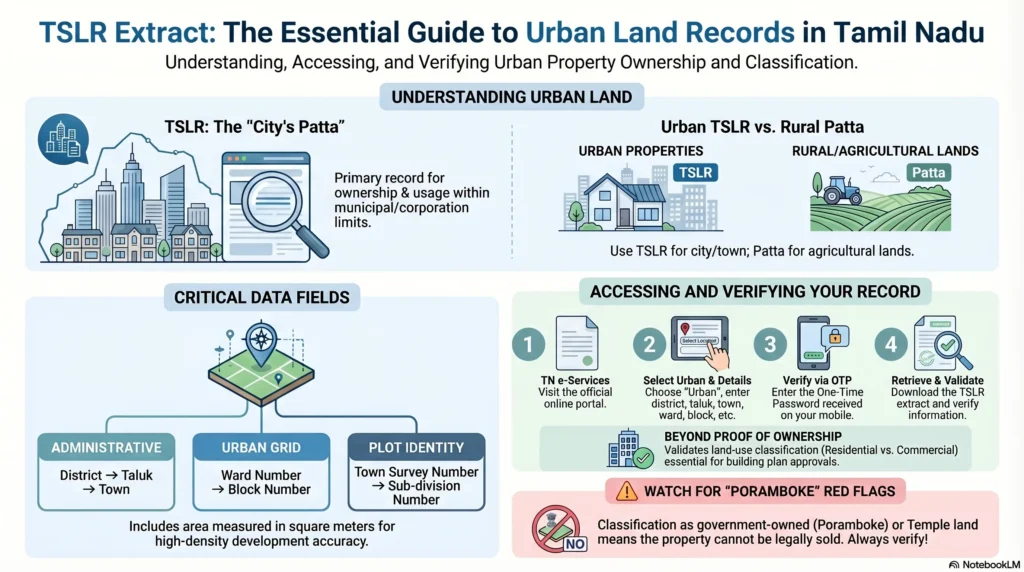
The TSLR extract is the official urban land record issued by the Directorate of Survey and Settlement via the local Taluk office or Urban Land Records department. Functioning as the urban counterpart to the rural Patta, it provides a comprehensive overview of a property’s legal status within municipal and corporation limits. It identifies the registered owner, defines precise boundaries, and classifies land use (such as residential, commercial, or government-owned). In the eyes of the Tamil Nadu government, if your urban property is not entered correctly in the Town Survey Land Register, your title remains effectively incomplete.
TSLR vs. Patta Chitta: Understanding the Critical Differences
One of the most common points of confusion for investors is the distinction between TSLR and Patta Chitta. As a matter of Revenue Standing Orders (RSO), the application of these documents is strictly geographical.
| Feature | TSLR Extract | Patta Chitta |
| Geography | Urban, Municipal, and Corporation areas. | Rural, Village, and Panchayat areas. |
| Measurement Units | Strictly Square Meters. | Hectares, Ares, and Acres. |
| Issuing Authority | Directorate of Survey and Settlement. | Revenue Department (Tahsildar). |
| Land Identifiers | Town, Ward, Block, and Survey/Subdivision. | Survey and Subdivision Numbers. |
| Tax Type | Assessment of Ground Rent. | General Land Revenue. |
Anatomy of a TSLR Extract: Key Data Points Explained
A TSLR extract is more than just a certificate; it is a technical data sheet of your property. You must verify each of the following:
- Location Identifiers: Explicit details of the Town, Ward number, and Block number.
- Survey and Subdivision (SD) Records: Both the New Survey Number and the specific Subdivision Number must match your Sale Deed.
- Ownership Information: The registered owner’s name and father’s name. Note: Any discrepancy here requires immediate Mutation.
- Land Classification: Identifies if the land is a “House-site,” “Commercial,” or the dreaded “Poramboke” (Government land).
- Physical Extent: Urban land is quantified in Square Meters. Conversion errors from archaic units are a frequent source of litigation.
- Assessment Details: Lists the Ground Rent assessment and the specific volume/page entry in the master register.
The Legal Weight of TSLR: Why You Need It
The TSLR carries immense legal weight, governed by the Transfer of Property Act and various court precedents.
- Loan and Title Verification: Banks will not sanction a mortgage without a TSLR extract, as it serves as the primary proof of the seller’s right to convey.
- Regulatory Approvals: Mandatory for obtaining building permissions from the CMDA (Chennai Metropolitan Development Authority) or DTCP.
- Fraud Prevention: It protects buyers from purchasing “Poramboke” or “Meikkal” land that belongs to the state.
- The Dorairaj Precedent: In the landmark case of K. Dorairaj vs. Radhakrishnan (2025), the Madras High Court cited Section 55(1)(b) of the Transfer of Property Act, ruling that a seller’s failure to produce a valid Patta/TSLR justified the buyer’s claim for specific performance. This case was particularly significant because it involved discrepancies between modern survey records and archaic Kani units or Paimash numbers. The TSLR is the modern instrument used to “clean” these historical discrepancies.
Step-by-Step Guide: How to View and Download TSLR Online
The Tamil Nadu government has digitized these records through the eservices.tn.gov.in portal. Follow these precise steps:
- Portal Access: Navigate to the official e-Services portal.
- Select Service: Choose “View Patta & FMB/Chitta/TSLR Extract.”
- Area Selection: Select the “Urban” radio button.
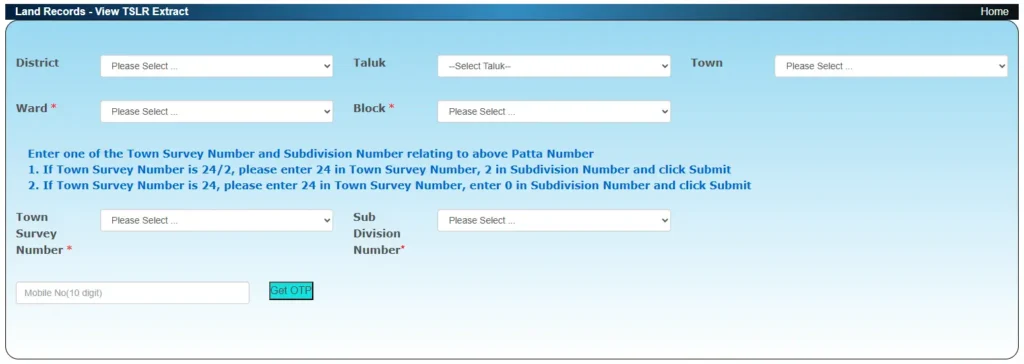
- Input Parameters: Select your District, Taluk, Town, Ward, and Block from the dropdown menus.
- Survey Entry: Enter the Survey Number and Subdivision Number.
- Authentication: Enter your mobile number for OTP verification and solve the Captcha.
- Download: Save the resulting PDF. Consultant’s Tip: Always verify the Unique Reference Number at the bottom of the extract via the “Verify Web Issued Extract” feature to ensure the document hasn’t been tampered with.
Patta/TSLR Transfer and Mutation: The Process of Changing Ownership
After a sale, gift, or inheritance, you must perform a Mutation (Transfer of Registry). This is governed by RSO 23, 23A, and 24.
- Fee Structure: The application fees are nominal, typically ₹100 to ₹300, payable online.
- Required Documents:
- Registered Sale Deed (The primary link document).
- Encumbrance Certificate (EC) for a minimum of 30 years.
- Parent Documents (The “Mother Deed” chain).
- ID Proof (Aadhaar/Voter ID).
- The Process: While DTCP-approved layouts may trigger automatic mutation, most urban properties require a manual application through the portal or a Common Service Center (CSC).
The “Poramboke” and “Meikkal” Alert: Consultant’s Warning
Before you sign any agreement, check the Prohibitory Order Book (P.O.B.). One of the greatest risks is land classified as Poramboke (Government land).
- Meikkal (Grazing Ground): Conversion of Meikkal land is a bureaucratic nightmare. Per the Land Administration Handbook 2023, converting such land requires a development charge of ₹15,000 per hectare to be remitted to the local body. Furthermore, the applicant must identify an equal extent of land elsewhere in the district for cattle grazing—a hurdle that stalls most private developments.
- Restricted Categories: Always verify that the land is not classified as Waterbodies (Kulam/Vaikkal) or Temple Lands (HR&CE), where construction is strictly prohibited.
Ancillary Records: A-Register, FMB, and Adangal
To complete your due diligence, cross-reference the TSLR with these ancillary records:
- A-Register: The master ledger containing the land’s history, classification, and tax assessment.
- FMB (Field Measurement Book): A precise sketch showing boundaries and neighboring survey numbers. Ensure the digital FMB matches the physical fencing on-site.
- Adangal: Primarily for rural or “Natham” land, it records tenancy, crops, and land usage history.
Pre-Purchase Checklist: Expert Verification Tips
As a Senior Consultant, I recommend this checklist for every urban investor:
- Check Territorial Restrictions: Be aware that “Enter Upon Permission” for government land is strictly prohibited within a 32km radius of Chennai and a 16km radius of other Municipal Corporations without prior approval from the Commissioner of Land Administration.
- Verify the Paimash Link: For properties in older parts of Chennai, ensure the link between old Paimash numbers and the current Town Survey numbers is legally established in the TSLR.
- Joint Patta Warning: Avoid properties under a “Joint Patta” unless all co-owners are parties to the sale; individual mutation is significantly harder to achieve afterward.
- Physical vs. Digital: Always measure the land area in Square Meters on-site and compare it against the TSLR “Extent” column.
Frequently Asked Questions (FAQs)
Can I get a TSLR for property in the heart of Chennai?
Yes. TSLR is the primary revenue record for all urban properties within the Greater Chennai Corporation.
What is the significance of Paimash vs. Survey Numbers?
Paimash numbers are archaic pre-survey identifiers. A TSLR is necessary to verify how those old numbers were converted into modern, legally recognized Survey and Subdivision numbers.
What is the validity of a web-issued TSLR?
While valid for preliminary checks and loan processing, a certified copy from the Taluk office is often preferred for high-value registrations or court proceedings.
How do I handle errors in the “Extent” field?
You must file a petition for “Rectification of Errors” at the Taluk office. This often requires a fresh survey by the Town Surveyor.
Conclusion: The Future of Digital Land Records in TN
The digitization of the TSLR system represents a paradigm shift in Tamil Nadu’s land administration. By utilizing the e-Services portal, the government has introduced a level of transparency that was previously non-existent. For property owners, the mandate is clear: digitize your records, ensure your TSLR is updated through mutation, and always conduct a professional revenue audit before any transaction. In the modern urban landscape, your TSLR is not just a document—it is your ultimate protection against land grabbing and legal uncertainty.