Navigating real estate transactions in Tamil Nadu requires strict due diligence, and no document is more critical to this process than the Encumbrance Certificate (EC). In the past, property buyers and sellers had to rely on manual searches through thousands of paper ledgers. Today, the Tamil Nadu Registration Department has transitioned into a sophisticated digital powerhouse through the TNREGINET portal. Maintained by Tata Consultancy Services (TCS) and managed by the Inspector General of Registration (IGR), this portal acts as a centralized repository for retrieving property documents and verifying land ownership.
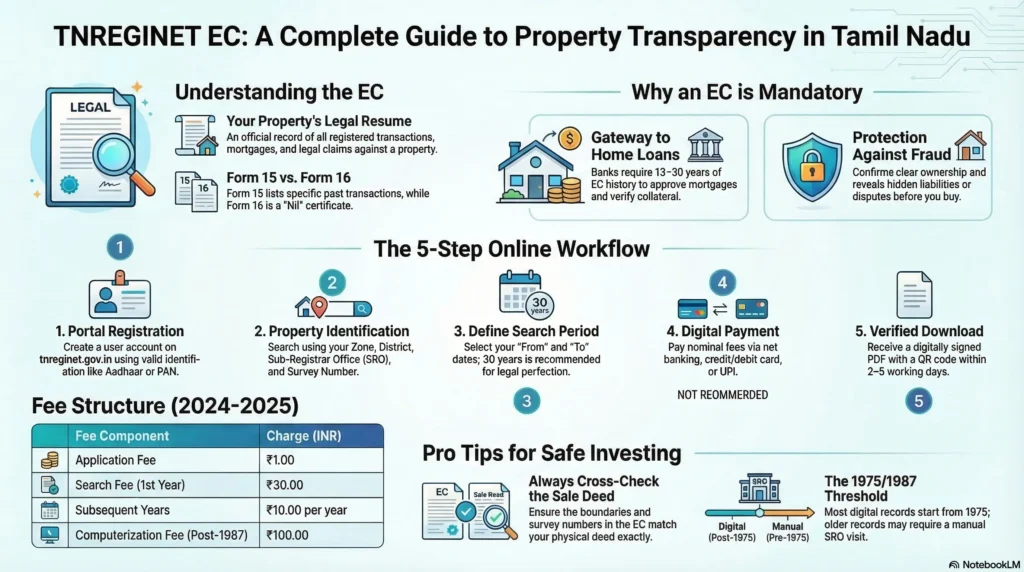
What is an Encumbrance Certificate (EC) in Tamil Nadu?
An Encumbrance Certificate—commonly referred to in Tamil Nadu as a “Villangam Certificate”—is an official legal document that confirms whether a specific property is free from monetary or legal liabilities. The term “encumbrance” refers to any legal or financial burden that restricts the usage or ownership of the property, such as pending mortgages, unreleased bank loans, or court attachments.
Serving as the ultimate proof of a clear title, the EC provides a chronological record of all registered transactions associated with a land parcel or building. It is an indispensable tool for mitigating risk and ensuring transparency in the state’s bustling real estate market.
Types of EC: Form 15 vs. Form 16
Within the Tamil Nadu legal taxonomy, Encumbrance Certificates are categorized into two distinct forms based on the outcome of your property search.
- Form 15: This document is generated when the search reveals existing registered encumbrances on the property. Form 15 provides a comprehensive transaction history, logging all sales, transfers, leases, gift deeds, and mortgages associated with the property during the specified search period. For prospective buyers, this form acts as a vital risk assessment tool, highlighting unreleased mortgages or historical ownership disputes that need to be cleared before purchase.
- Form 16: This form is issued when no registered transactions, loans, or liabilities are found for the specified search period.
What Does a “Nil EC” Mean?
Form 16 is widely known as the “Nil Encumbrance Certificate” or “Nil EC”. A Nil EC is highly sought after by buyers and financial institutions because it provides a “Nil” statement confirming the property has a clear and marketable title, free from registered disputes.
However, it is crucial to note a legal limitation: a Nil EC only reflects transactions that have been officially registered with the government. Private, unregistered agreements or informal long-term leases will not appear on this certificate.
How to View and Download Your TNREGINET EC Online
The TNREGINET portal offers two primary access tiers: a Guest Access facility for quick, free “Villangam” document viewing, and a Registered User portal for official, digitally signed applications. To apply for a legally valid, digitally signed Encumbrance Certificate, you must complete a formal user registration process requiring an Aadhaar or PAN card, mobile number, and OTP verification.
Step-by-Step Search Process (Property-wise vs. Document-wise)
The portal provides two multi-dimensional search parameters to help users retrieve property records efficiently:
- EC Search (Property-wise): This is the most common method. To perform a property-wise search, you must enter specific geographic identifiers into the portal. This includes the Zone, District, Sub-Registrar Office (SRO) jurisdiction, and Village. Crucially, you must provide the exact Survey Number and Subdivision Number to isolate the specific land parcel. You must also define a search period (from and to dates), with digital records typically available from January 1, 1975, or 1987 onwards depending on the specific SRO.
- Document-wise Search: If you already possess the specific registration details of the property, you can bypass the geographic search. This method requires you to input the SRO, the document number, the year of registration, and the document type. This is particularly useful for verifying the closure status of a specific mortgage or a recent sale deed.
Required Details and Documents for Application
If you are applying for an EC online via TNREGINET, you do not need to upload physical documents; you simply need accurate property identifiers (Zone, District, Survey Number, etc.).
If you choose to apply offline at a Sub-Registrar’s Office, you must submit a completed Form 22 alongside an attested copy of your address proof, property details, and property registration documents. Once the online application is submitted and payment is verified, a digitally signed PDF with a QR code becomes available for download directly from your TNREGINET dashboard.
TNREGINET EC Fees and Processing Times
The Tamil Nadu Registration Department has structured its fiscal policy to make property verification highly affordable.
Fee Schedule:
- Application Fee: ₹1.00 (Mandatory for every EC request).
- General Search Fee (1st Year): ₹15.00 to ₹30.00 (Covers the first year of records).
- Subsequent Years: ₹5.00 to ₹10.00 (Charged for each additional year searched).
- Computerization Fee: ₹100.00 (Applicable for records searched from 1987 onwards).
Processing Times: The digitalization of the EC process has drastically reduced wait times. When applying for an Encumbrance Certificate online, the processing time is typically 2 to 5 working days. In contrast, applying offline through a physical Sub-Registrar’s office requires manual ledger searches and can take anywhere from 15 to 30 days.
Why is the EC Important for Property Transactions?
The TNREGINET EC acts as the central node in a complex web of legal and financial relationships. It is the ultimate safeguard against financial risk in the real estate market.
Benefits for Buyers, Sellers, and Bank Loans
- For Buyers: The EC acts as an essential due diligence tool. It protects buyers by confirming that the seller is the latest, legally recognized owner and that the property extent matches the sale agreement. It ensures the buyer does not unknowingly inherit someone else’s financial liabilities.
- For Sellers: Real estate developers and individual sellers use a fresh EC to demonstrate a “clear marketable title” to prospective buyers. Clearing existing encumbrances and sharing an updated EC is considered an industry best practice to facilitate rapid sales.
- For Bank Loans: Financial institutions absolutely rely on the EC as the primary document for risk assessment and collateral evaluation. Banks typically demand a 13-to-30-year EC to ensure the property is entirely encumbrance-free before approving a Home Loan or Loan Against Property. If an active mortgage entry is found, the loan will be immediately rejected until a “Discharge Receipt” is officially registered.
Common Issues and How to Rectify Mistakes in Your EC
Operating in a digital-first environment comes with unique administrative challenges. Users frequently encounter issues such as “Payment Pending” statuses, missing digital records for transactions prior to 1975 (which require manual SRO searches), and jurisdictional disputes where searching the wrong SRO yields a false “Nil EC”.
The most critical issue arises when there is a typographical error on the EC itself—such as a misspelled name or an incorrect survey number. Because the EC is a permanent government ledger, you cannot simply edit the online record.
To rectify mistakes in an Encumbrance Certificate, you must execute a Rectification Deed (also known as a Correction Deed or Amendment Deed). This rigorous process requires both the buyer and the seller to be physically present at the Sub-Registrar’s Office to officially acknowledge and register the correction. While time-consuming, this strict protocol ensures the ultimate integrity of Tamil Nadu’s land records.