1. Introduction: A Digital Revolution in Food Security
The transition from legacy paper-based booklets to the TNPDS Smart Ration Card represents a sophisticated socio-technical evolution in Tamil Nadu’s welfare administration. Managed via the Tamil Nadu Electronic Public Distribution System (TNePDS), this digital infrastructure serves as the primary vehicle for the “No One Hungry” mandate. By achieving “Zero Hunger” (UN Sustainable Development Goal 2), the state has empowered over 2,24,13,920 households through a transparent, QR-code-enabled ecosystem. This system replaces manual ledgers with end-to-end computerization, ensuring that nutritional security is a frictionless digital right for every resident.
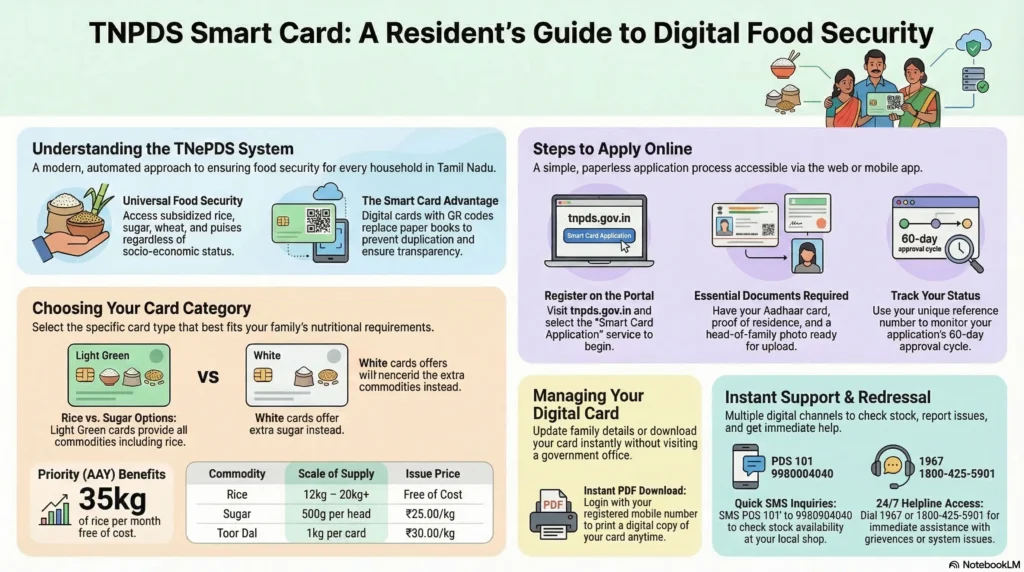
2. Understanding the TNPDS Philosophy: Universal vs. Targeted PDS
While the National Food Security Act (NFSA) 2013 utilizes a Targeted PDS (TPDS) model, Tamil Nadu has pioneered a Universal Public Distribution System for over five decades. This specialist approach ensures nutritional security is extended to all citizens without socio-economic discrimination. The operational efficiency of this system is maintained through a rigorous three-tier administrative reach:
- Policy Governance: Oversight across 39 districts ensuring strategic alignment with state food security goals.
- Supply Chain Optimization: Localized management via 318 taluks and 268 specialized warehouses (godowns).
- Last-Mile Point of Sale (PoS) Deployment: A massive network of 36,954 Fair Price Shops (FPS) as of May 31, 2024, ensuring no cardholder travels more than 1.5 km in plain areas.
3. Decoding Smart Card Categories: Which One Do You Have?
The TNePDS classifies family cards into five distinct categories to harmonize the Universal PDS philosophy with NFSA guidelines.
| Card Type | Physical Colour/Tag | Entitled Commodities | Total Cards (as of 31.05.2024) |
| Priority Households (PHH) | Light Green | All commodities including Rice. | 95,81,846 |
| Antyodaya Anna Yojana (PHH-AAY) | Light Green | All commodities; poorest of the poor entitlement. | 18,64,099 |
| Non-Priority Households (NPHH) | Light Green | All commodities including Rice. | 1,05,22,987 |
| Sugar Option Cards (NPHH-S) | White | All commodities except Rice (Additional sugar). | 3,80,280 |
| No Commodity Cards (NPHH-NC) | White | No commodities; Identity/Residence proof only. | 64,708 |
Technical Precision: Police and Uniformed Services Cards
Non-Priority Household (NPHH) cards issued to personnel in the Police, Prison, and Forest Departments (up to the rank of Inspector) carry a “Police Card” designation in the database. These holders are entitled to essential commodities at specific subsidized rates: Sugar at Rs. 12.50, Tur Dal at Rs. 15.00, and Palmolein Oil at Rs. 12.50.
4. Subsidised Essentials: Commodity Scales and Pricing (2024-25)
Tamil Nadu’s pricing strategy intentionally overrides national scales to provide deeper subsidies.
- Rice & Wheat: Provided Free of Cost. Under the Universal PDS override, a single-member family receives 12 kg of rice (exceeding the NFSA 5 kg mandate). Larger families receive 5 kg per person.
- Sugar: AAY cardholders pay Rs. 13.50 per kg, while others pay Rs. 25.00 per kg.
- Special PDS items: Tur Dal is priced at Rs. 30.00 per kg and Palmolein Oil at Rs. 25.00 per litre pouch.
- Fortified Rice: To combat micronutrient deficiencies, the state distributes rice blended with Iron, Folic Acid, and B12 (1:100 ratio). Mandatory Safety Note: Individuals with Thalassemia or Sickle Cell Anaemia are advised to consume fortified rice only under medical supervision or avoid iron-fortified products.
5. How to Apply for a TNPDS Smart Card Online
Residents can initiate a new application through the apply for TNPDS smart card online service on the official portal.
- Portal Access: Navigate to tnpds.gov.in and select “Smart Card Application.”
- Data Entry: Input the Head of Family (HoF) details, address, and LPG connection data.
- Digital Lifecycle Management – Documents:
- HoF Photo: Must be < 10kb (JPEG/PNG/GIF).
- Residence Proof: Upload scanned bank passbook, electricity bill, or tenancy agreement (< 100kb).
- Aadhaar Integration: Mandatory for all members (except children under 5).
- Reference Generation: Upon submission, the system generates a unique reference number sent via SMS for real-time tracking.
6. Tracking Status and Downloading Your Digital Card
Post-submission, users must monitor their application’s journey through the administrative verification tiers.
TNPDS Status Check
To track progress, visit the “Smart Card Application Status” section. Enter your reference number to view the real-time stage—ranging from “Field Verification” by Zonal Officers to “Approved” or “Rejected.”
Tamil Nadu Smart Ration Card Download
Once the application reaches “Approved” status, follow these steps:
- Select “Beneficiary Login” on the portal.
- Authenticate via the registered mobile number and OTP.
- Navigate to “Smart Card Print” in the dashboard.
- Download the PDF card. This digital version contains a secure QR code recognized at all 36,954 Fair Price Shops.
[Link: How to link Aadhaar with Ration Card]
7. Managing Your Family Profile: Updates and Corrections
The TNePDS ecosystem allows for “lifecycle management,” enabling users to modify their data without visiting Taluk Supply Offices.
- Add Member: Requires birth certificates for children or name deletion certificates for adults moving from other cards.
- Address Change: Requires a scanned copy of new residence proof (utility bill/passbook).
- Card Reprint: If lost or damaged, a duplicate card can be requested online for a Rs. 50 fee. Between April 2023 and May 2024, over 4.54 lakh cards were delivered directly to residents via India Post.
8. The TNePDS Mobile App and SMS Services
Strategic digital governance includes multi-channel access to prevent “bogus billing” and ensure transparency.
Advanced Biometric & IRIS Authentication
Tamil Nadu maintains a 98.5% biometric authentication success rate. For beneficiaries whose fingerprints fail due to age or labor-worn skin, the state has deployed IRIS scanners at Point of Sale (PoS) devices, ensuring no eligible citizen is denied food grains due to technical failure.
SMS Service Codes
Send these codes to 9980904040 from your registered mobile:
| SMS Code | Information Provided |
| PDS 101 | Shop Operational Status (Open/Closed) |
| PDS 102 | Real-time Stock Availability at your shop |
| PDS 107 | Immediate Billing/Overcharging Complaint |
Note: User feedback on the TNePDS mobile app highlights high security, though some note the frequent OTP requirement as a minor inconvenience for quick stock checks.
9. Grievance Redressal: Your Voice in the System
The system is backed by a robust legal and administrative redressal framework:
- Toll-Free Helplines: 1967 or 1800-425-5901.
- Online Portal: Submit detailed complaints (up to 5,000 characters) at tnpds.gov.in.
- DGROs: District Revenue Officers serve as District Grievance Redressal Officers to resolve persistent PDS issues.
Frequently Asked Questions (FAQs)
How much rice are AAY families entitled to?
Antyodaya Anna Yojana (AAY) families, identified as the poorest of the poor, are entitled to 35 kg of rice per month free of cost, regardless of family size.
Is there a fee for applying for a new Smart Card?
The online application is free. If processed offline through an Assistant Commissioner (AC) or Taluk Supply Officer (TSO), a nominal fee of Rs. 5 may apply.
What is the standard processing time for an application?
Typically, the verification cycle takes between 15 to 30 days.
What should I do if my application is “Pending” for over 30 days?
Contact your local AC or TSO office. Delays are often due to pending field verification or illegible document uploads.
Can I use my card in other states?
Yes, under the “One Nation One Ration Card” scheme, priority cardholders can draw entitled grains from any FPS in India via biometric authentication.
Conclusion: Sustaining Zero Hunger in Tamil Nadu
The TNPDS Smart Card system is a benchmark in digital governance, effectively linking food security with citizen empowerment. By aligning with SDG Goal 2 (Zero Hunger) and SDG Goal 7 (Clean Energy—evidenced by the state’s 104.8% LPG coverage originating from the 2006 free stove initiative), Tamil Nadu ensures a resilient social safety net.
The state’s commitment to infrastructure—including the mandate to move all FPS to state-owned buildings—ensures long-term stability. Beneficiaries are encouraged to keep their mobile numbers updated to benefit from the ongoing modernization of this vital ecosystem.