1. Introduction: More Than Just an Agency
When we evaluate the trajectory of a state’s development, we often look at physical infrastructure or industrial output. However, in the modern era, the most profound transformations occur behind the screens. The Tamil Nadu e-Governance Agency [TNeGA] is the master architect behind this invisible revolution. Far from being just another bureaucratic department, [TNeGA] serves as the primary engine driving the state’s vision to become a global “Innovation Hub and Knowledge Capital.”
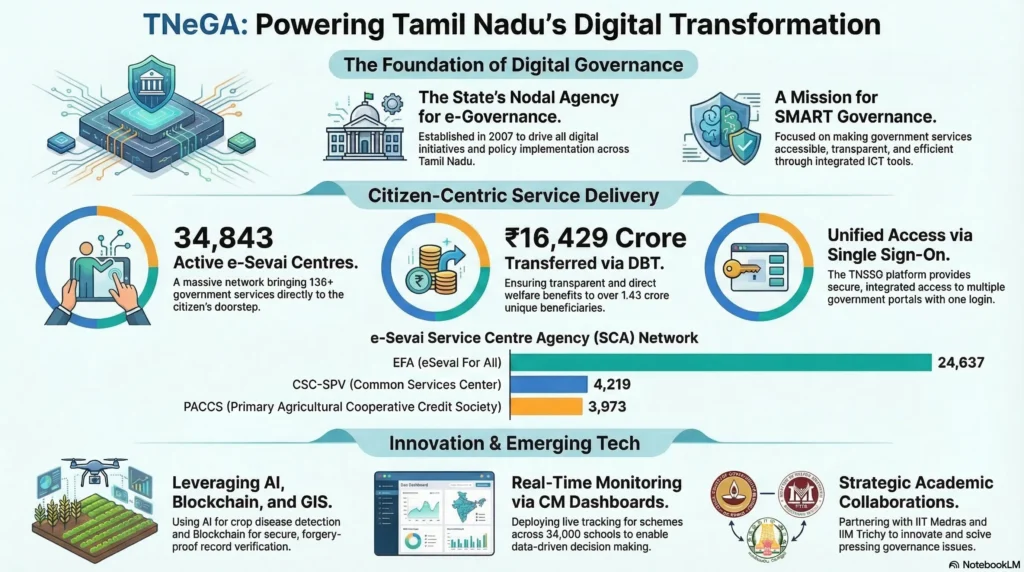
As a senior strategist in this space, I have observed many digital shifts, but the Tamil Nadu model stands apart. The mission of this [e-Governance Agency] is to dismantle traditional barriers between the government and the governed. By leveraging a robust suite of Tamil Nadu Digital Services, the state is effectively taking the “government to the citizens’ doorsteps.” Whether it is through predictive analytics or ensuring rural connectivity, TNeGA is setting the gold standard for “Good Governance” in India. Let’s dive into the specifics of how this agency is building a world-class digital ecosystem that prioritizes transparency, speed, and reliability.
2. The Foundation: Building a World-Class IT Infrastructure
To support millions of digital transactions daily, a state requires more than just software; it needs a resilient, multi-layered physical and virtual foundation. Tamil Nadu has meticulously constructed a [Tamil Nadu IT Infrastructure] that rivals international standards, managed through a seamless partnership between TNeGA and ELCOT.
TNSWAN (The Backbone)
The Tamil Nadu State Wide Area Network (TNSWAN) is the nervous system of the state’s digital body. Commencing operations in 2007, it has evolved into a massive network with 828 Points of Presence (PoPs). It provides integrated voice, data, and video services to over 3,000 government offices, including the Commercial Taxes Department and the Department of Treasuries and Accounts. This ensures that the internal pulse of the government is as rapid as the services it provides to the public.
TNSDC (The Brain)
Data is the lifeblood of modern governance. The Tamil Nadu State Data Centres (TNSDC-1 and TNSDC-2) serve as the central repository for hosting critical applications. Notably, TNSDC-1 was the first ISO-certified State Data Centre in India, a landmark achievement that underscores the state’s commitment to quality and security. With TNSDC-1 fully utilized, TNSDC-2 is now active to handle the increasing demands of a digital-first administration.
National Knowledge Network (NKN) Integration
A strategic detail often overlooked by laypeople but vital to a senior architect is the integration of the National Knowledge Network (NKN). This multi-gigabit network connects TNSWAN and TNSDC with 1 Gbps connectivity. This allows user departments to access high-level applications and research establishments across India at lightning speeds, ensuring Tamil Nadu is never siloed from the national digital grid.
Thamizh Megam (The Cloud)
To enhance scalability, the state has registered its own cloud brand: “Thamizh Megam.” This environment offers both Infrastructure-as-a-Service (IaaS) and Platform-as-a-Service (PaaS). It allows government departments to scale their applications dynamically based on demand, avoiding the “lag” often associated with traditional hardware procurement.
TNDRC (The Safety Net)
Digital systems are vulnerable to natural and man-made disasters. To mitigate this, the Tamil Nadu Disaster Recovery Centre (TNDRC) was established in Tiruchirappalli. Located in a different seismic zone than the primary data centres in Chennai, it ensures that even in a worst-case scenario, critical governance services remain uninterrupted.
3. TNeGA’s “Digital Village” Initiative: Transforming Rural Tamil Nadu
One of the most ambitious [TNeGA projects] is the Digital Village pilot. You might be wondering: how can digital tools change a life in a remote Gram Panchayat? The strategy here represents a paradigm shift—moving from a traditional “infrastructure-focused” approach to a “service-delivered” model.
The Digital Village pilot aims to bridge the rural-urban divide by demonstrating the potential of digital technologies to improve the quality of life. By providing a “market pull” for telecom players to bring 3G and 4G to unreached areas, the state is making connectivity a basic right.
Key Sub-Components of the Digital Village:
- Tele-Medicine Services: This is a literal lifesaver for populations with limited access to specialists. A group of Primary Health Centers (PHCs) is partnered and linked to lead hospitals at the district or state level. Local paramedical staff interact with expert doctors via tele-medicine solutions, providing early diagnostics that prevent minor issues from becoming fatal.
- Tele-Education Services: To combat the shortage of specialized teachers in subjects like Mathematics and Science, rural schools are partnered and linked with reputed “lead schools.” Interactive teaching platforms allow students in remote villages to receive the same quality of instruction as those in urban hubs.
- LED Lighting & Information Dissemination: Each Gram Panchayat features a central LED tower. Not only does this provide 4–5 hours of free lighting in the evening, but it also hosts a display board used to disseminate vital information regarding government schemes and social awareness.
- WiFi Hotspots: As part of digital empowerment, residents receive 30 minutes of free internet access daily. Crucially, access to essential government sites like e-District is permitted for a longer duration (up to 4–5 hours), ensuring citizens can complete their administrative tasks without data anxiety.
- Skill Development & Resource Centers: These centers use video conferencing (VC) to host interactive sessions with experts. For example, farmers can receive real-time training on crop diseases or cattle rearing, facilitating proactive measures to prevent outbreaks.
4. ELCOSEZ: Driving Economic Growth and IT Promotion
To truly understand the “Senior Strategist” view of Tamil Nadu, one must look at the ELCOT Special Economic Zones (ELCOSEZs). These are not just office parks; they are economic engines designed to take the IT revolution to Tier-II cities. Across 1,321.61 acres, the state has invested Rs. 664.88 crore, creating 94,000 direct jobs and generating software exports estimated at Rs. 21,700 crore for the 2019-20 period alone.
The Eight Pillars of IT Promotion:
- Sholinganallur (Chennai): The crown jewel, spanning 377.08 acres. It hosts giants like Wipro, HCL, and Ford, employing over 68,000 people. A new 2.33 lakh sq. ft. IT Tower is currently under construction to expand this footprint.
- Vilankurichi (Coimbatore): A 62-acre hub where TIDEL Park and Wipro operate with over 14,000 employees. A new IT Tower of 2.66 lakh sq. ft. is also in the pipeline here.
- Ilandhaikulam (Madurai): Focuses on BPO and data digitization, housing companies like Honeywell and HCL. It currently supports 5,900 employees across its allocated land and IT building.
- Vadapalanji (Madurai): A massive 213-acre site featuring a dedicated Rail Over Bridge to ensure seamless logistics for companies like Tech Mahindra and Sutherland.
- Navalpattu (Tiruchirappalli): Specializing in e-publishing and gaming software, this 123.23-acre zone is expanding with a new 1.16 lakh sq. ft. IT Tower.
- Gangaikondan (Tirunelveli): A 290-acre zone where Syntel has constructed a 2.60 lakh sq. ft. building, providing high-tech software services in the deep south.
- Jagirammapalayam (Salem): An emerging hub for IoT, AI, and Big Data, hosting innovative firms like Knowledge Lens and Vee Technologies across 53.33 acres.
- Viswanathapuram (Hosur): Leveraging its proximity to Bengaluru, this 174.47-acre zone focuses on semiconductor testing and software development with companies like UST Global.
5. Cutting-Edge Tech: AI, Blockchain, and Drones
Tamil Nadu isn’t just following tech trends; it is pioneering them through the Centre of Excellence (CoE) in Emerging Technologies (CEET). This is where the state implements [Blockchain in TN] and AI to solve real-world governance problems.
Nambikkai Inaiyam: The Blockchain Backbone
“Nambikkai Inaiyam” (meaning “Hope Link”) is the state’s secure blockchain infrastructure. By creating a “Single Source of Truth,” the state ensures that certificates, licenses, and documents are tamper-proof. This eliminates the “trust deficit” in government-citizen interactions.
Predictive Service Delivery & Zero Knowledge Proof
Perhaps the most futuristic of all [TNeGA projects] is the move toward predictive service delivery. By leveraging the State Family Database (SFDB) and “Zero Knowledge Proof” protocols, the government can identify when a citizen is eligible for a benefit—such as a scholarship or a social security pension—and deliver it before the citizen even applies. This is the ultimate “take government to the citizen” strategy.
AI Solutions: Anil and Crop Protection
Artificial Intelligence is being humanized in Tamil Nadu. The “Anil” chatbot is a smart conversational assistant that uses Natural Language Processing (NLP) to answer queries in Tamil. For the agricultural sector, the AI-based Pest Identification System allows farmers to upload photos of their crops to receive instant mitigation advice, protecting the state’s food security.
Drones as a Service (DaaS)
Drones are no longer toys; they are essential tools for mapping, disaster management, and agricultural surveillance. TNeGA’s DaaS model allows various departments to access high-resolution aerial data without the need to maintain their own drone fleets.
6. Streamlining Administration: Internal Governance Tools
For citizen-centric services to thrive, the internal machinery must be optimized. TNeGA and ELCOT have introduced specialized tools to synchronize administrative processes. A key strategic addition is the State Resident Data Hub (SRDH), which provides a unified authentication layer for all internal systems.
Administrative Efficiency Tools
| Tool Name | Primary Benefit |
| Cloud-Based Asset Management | Tracks IT/Non-IT assets, maintenance costs, and warranty expirations with unique IDs and image logging. |
| Customer Relationship Management (CRM) | Automates inter-departmental interactions and citizen feedback using SRDH for secure authentication. |
| e-Repository Management System | Ensures source code traceability and documentation continuity, preventing vendor lock-in. |
| e-Office | A mission-mode project to eliminate paper-based files and enhance the “velocity” of decision-making. |
| Digi Archives | A workflow-based system for the Tamil Nadu Historical and Research Department to digitize and store historical files. |
| Know Your Government (KYG) | A unified platform for citizens to find information on all government departments. |
| e-Taal | An aggregation layer that analyzes the volume and impact of electronic transactions in real-time. |
Additionally, the e-Governance Standards Manual has been developed. Unlike traditional prescriptive standards, this manual encourages the use of frontier technologies while focusing on the “Time” dimension—ensuring the government works at the speed citizens expect (24 x 365).
7. Citizen-Centric Services: Arasu e-Sevai and Aadhaar
The ultimate goal of e-Governance is the [e-Sevai centres]. These are the physical touchpoints where digital strategy meets the common man. Operated by TACTV and ELCOT under TNeGA’s registrarship, these centers have revolutionized document processing.
Aadhaar is the cornerstone of this delivery. Serving as the Registrar for Aadhaar in Tamil Nadu, TNeGA has established 518 Permanent Enrollment Centres (PECs) equipped with 612 kits. These centers are vital for keeping the State Population Register (SPR) updated. It is important to note the historical progress here: between October 2016 and 15th May 2017, TNeGA-led initiatives saw over 22.45 lakh Aadhaar enrollments, providing a vital foundation for the direct-to-benefit authentication systems we see today.
8. Competitor Analysis: How Tamil Nadu Leads the Way
Tamil Nadu’s model is frequently cited as a national role model because it integrates infrastructure with emerging tech and citizen delivery. While other states may have siloed projects, Tamil Nadu has a holistic roadmap.
Tamil Nadu’s e-Gov Model vs. Traditional State Models
| Criteria | Tamil Nadu’s Integrated Model | Traditional Fragmented Models |
| Connectivity | BharatNet/TamilNet connecting 12,524 Village Panchayats at 1 Gbps. | Fragmented networks with limited last-mile rural reach. |
| Emerging Tech | Proactive use of Blockchain (Nambikkai Inaiyam) and AI (Safe & Ethical AI Policy). | Reactive use of technology, often limited to pilot programs. |
| Citizen Access | Ubiquitous [e-Sevai centres] and Predictive Service Delivery via SFDB. | Multiple disconnected portals requiring repetitive data entry. |
| Cloud Identity | Dedicated “Thamizh Megam” trademarked cloud for IaaS/PaaS. | Reliance on generic third-party hosting without state-level branding. |
9. Security and Capacity Building
As we expand the [Tamil Nadu IT Infrastructure], security becomes paramount. The Cyber Security Architecture for Tamil Nadu (CSA-TN), implemented in collaboration with C-DAC, provides a multi-layered defense. This includes real-time monitoring via SIEM tools, Vulnerability Assessment and Penetration Testing (VAPT), and regular audits by CERT-In empanelled experts to prevent defacement and hacking.
Furthermore, TNeGA understands that e-governance is essentially about people. The Capacity Building mission mode project focuses on three pillars:
- Human Resource Development: Equipping officials with the skills to operate in a digital environment.
- Organizational Development: Refining management structures between the public and private sectors.
- Policy Support: Providing decision-makers with the technological resources needed to navigate complex choices like the “Safe & Ethical AI Policy.”
10. Conclusion: The Roadmap to 2023 and Beyond
The journey of the Tamil Nadu e-Governance Agency is a testament to what is possible when political will meets technological vision. Through the goals of “Vision 2023,” the state is transforming into a global “Innovation Hub.” By combining world-class [Tamil Nadu IT Infrastructure] with citizen-centric services like the Digital Village and the Nambikkai Inaiyam blockchain, TNeGA is not just keeping pace with the future—it is defining it.
For the citizens of Tamil Nadu, this means a government that is more accessible, more transparent, and more efficient. Whether you are an entrepreneur in an ELCOSEZ or a student in a Digital Village, the benefits of this digital revolution are designed for you. I encourage every resident to engage with these services, visit their local [e-Sevai centres], and embrace a future where the government truly works for you at the click of a button.