In the modern real estate landscape, understanding the Guideline Value is the essential first step for any property transaction in Tamil Nadu. As we move into 2026, search habits have evolved from simple keyword lookups to intent-based queries. Property buyers are no longer just looking for a number; they are seeking a bridge between government-mandated floor rates and actual market demand. This guide provides a deep dive into the TNREGINET portal and the recent fiscal reforms—such as the Composite Value system—that define property acquisition today.
What is Guideline Value and Why Does It Matter?
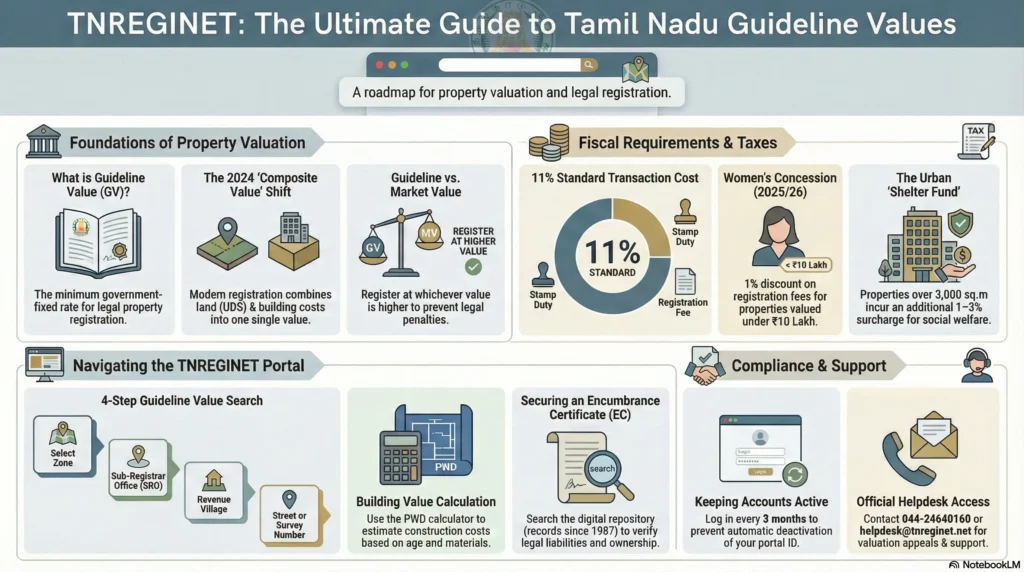
The Guideline Value (GV), also known as the circle rate or guidance value, is the minimum rate set by the state government for property registration in a specific locality.
The Legal Floor for Registration
The GV represents a “legal floor”; no property can be registered below this value during a sale or title transfer. This benchmark prevents property undervaluation, which is often used to facilitate the transfer of “black money” in real estate deals. If a sale occurs at a price higher than the GV, taxes are paid on that higher transaction value. Conversely, if the sale price is lower than the GV, the government still mandates that stamp duty be paid on the government’s minimum rate.
Guideline Value vs. Market Value: The Gap
A nuanced understanding of the divergence between guideline and market value is critical.
- Market Value: The actual price agreed upon by a buyer and seller, influenced by demand, supply, and infrastructure development.
- Guideline Value: A semi-static figure determined by the government based on historical transaction data and surveys.
In rapidly growing areas like Nanganallur in Chennai, market rates can reach ₹12,000 per sq. ft., while the official guideline rate may be as low as ₹4,500.
Navigating the TNREGINET Portal
Managed by the Inspector General of Registration (IGR), the TNREGINET portal is the digital cornerstone of property administration in the state.
How to Check Guideline Value Online
- Visit the Official Portal: Go to tnreginet.gov.in.
- Select the ‘Guideline Value’ Option: This is typically found on the homepage menu bar.
- Choose the Effective Date: Select the period for which you want to check (e.g., “From 01-07-2024”).
- Enter Property Details: Select your Zone (e.g., Chennai, Madurai), Sub-Registrar Office (SRO), and Revenue Village.
- Search by Street or Survey Number: Urban users usually search by street name, while rural users use the Survey Number.
The Challenge of Survey Numbers
For rural properties, the Survey Number is a unique, permanent identifier assigned by the Revenue Department. Users on platforms like Reddit often report technical difficulties with these fields; the portal may reject special characters like hyphens (-) or slashes (/), requiring the main number and subdivisions to be entered separately or as a continuous string.
The 2024 Transition: From UDS to Composite Value
The most significant structural reform since January 2024 is the shift to the Composite Value system for apartments and villas.
What is Composite Value?
Previously, buyers registered the Undivided Share (UDS) of the land and a separate construction agreement. This dual system was prone to tax manipulation and created assessment challenges for banks. The new system mandates registering the entire property in a single document using a consolidated value.
What determines the Composite Value?
The government integrates several key parameters to reach this figure:
- Super Built-up Area: The total flat area including common spaces.
- UDS Component: The proportional share of the underlying land.
- Building Quality: Factors like construction materials and structural type.
- Common Amenities: Shared facilities like gyms, clubhouses, and internal roads.
While this change may lead to a perceived increase in registration costs, it provides a more robust legal title and streamlines the home loan process.
Detailed Fiscal Analysis: Stamp Duty & Registration 2026
Tamil Nadu maintains some of the highest property acquisition taxes in India.
Standard Charges for 2025–2026
For a standard sale deed, the cost is approximately 11% of the property’s value (market or guideline, whichever is higher):
- Stamp Duty: 7%.
- Registration Fee: 4%.
Progressive Reforms and Concessions
To support social equity, the government has introduced targeted concessions:
- Gender-Based Discount: Effective 1 April 2025, the registration fee for women is reduced to 3% for properties valued up to ₹10 lakh.
- Intra-Family Transfers: Deeds of partition or settlement between immediate family members attract a 1% stamp duty (capped at ₹25,000) and a 1% registration fee (capped at ₹4,000).
The Shelter Fund Surcharge
For large property transactions involving an area greater than 3,000 square metres, an additional Shelter Fund surcharge of 1% to 3% is levied. This revenue is dedicated to urban rehabilitation programs for the underprivileged.
Conclusion: Toward a Transparent Ecosystem
The TNREGINET guideline value system has evolved from a passive record into a dynamic instrument of fiscal policy. From the implementation of the Composite Value system to the shift toward Year-Round Revisions, the state is formalising the real estate sector and maximizing revenue efficiency.
For professionals and investors in 2026, success requires more than just searching for a rate; it necessitates a deep understanding of legal frameworks and the technical proficiency to navigate a digitised property market.